
Introduction
U.S. healthcare systems are among the nation's most energy-intensive organizations, accounting for approximately 9% of total domestic carbon emissions. Globally, the U.S. healthcare sector represents 27% of the total healthcare carbon footprint — ranking it as the 13th largest carbon emitter in the world if it were a country.
To address these impacts, a leading energy infrastructure solutions provider partnered with a nationally recognized healthcare organization to deploy on-site solar photovoltaic (PV) generation. This project serves as a cornerstone for broader grid modernization, reducing Scope 1 and Scope 2 emissions while improving operational resiliency for critical medical services.
Challenges
The healthcare industry faces a "triple threat" regarding energy and environmental impact:
Emission Intensity
Approximately 40% of global healthcare emissions stem from the generation and distribution of electricity, gas, heating, and cooling.
Grid Dependency
Hospitals rely on centralized grids that are increasingly stressed by extreme weather and rising demand.
Financial Pressure
Escalating energy costs and "peak demand" charges place additional financial pressure on healthcare providers.
Background
The client approached Branham Group with aggressive sustainability targets: a 50% reduction in Scope 1 and Scope 2 emissions by 2030, carbon neutrality by 2030, and net-zero emissions by 2050.
Hospitals operate 24/7 and require absolute energy reliability. Branham Group was engaged to design and install an on-site solar PV system at a major hospital campus to meet these decarbonization goals without compromising critical care operations.
- 50% reduction in Scope 1 and Scope 2 emissions by 2030
- Carbon neutrality by 2030
- Net-zero emissions by 2050

Solution
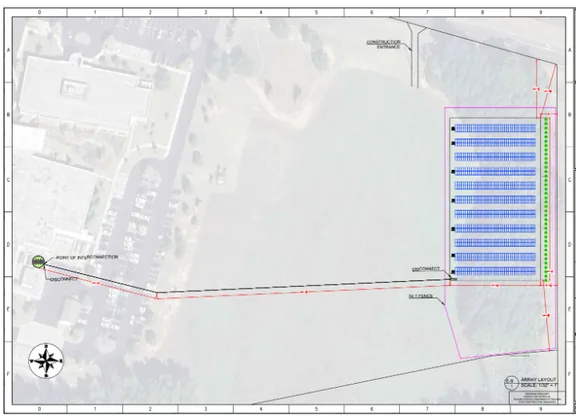
Branham Group implemented a facility-based solar energy system supported by modernized electrical infrastructure. The system utilizes a zero-export approach, ensuring 100% of the clean energy produced is consumed directly by the hospital facility to offset high-cost utility power.
Key Technical & Economic Elements:
Capacity
Over 692,000 kWh of annual power production.
Annual Savings
Based on average commercial healthcare rates, this system is projected to save the facility approximately $85,000 to $110,000 in Year 1 energy costs.
Lifetime Value
Over a 25-year system life, the project is estimated to provide over $2.5 million in cumulative savings, factoring in conservative utility price inflation.
Integration
Seamless connection with existing infrastructure to ensure uninterrupted power for the facility's critical requirements.
Future-Proofing
A modular design that allows for future expansion and improved grid modernization.
Advantages & Supporting Data
Industry research and project modeling demonstrate that on-site solar delivers measurable value across environmental, operational, and financial dimensions:
Emissions Reduction
Offsets approximately 490 metric tons of CO₂ annually — equivalent to the carbon sequestered by 580 acres of U.S. forests in a single year.
Cost Stability
Provides predictable, long-term energy expenditures that serve as a permanent hedge against volatile utility market spikes.
ROI & Incentives
With federal incentives like the Investment Tax Credit (ITC), similar healthcare installations typically achieve full ROI within 5 to 7 years, providing nearly two decades of essentially free energy thereafter.
Operational Resiliency
Enhanced reliability for mission-critical medical services during grid disruptions, ensuring patient safety remains uncompromised.
Advantages
The proposed solution delivers measurable value across environmental, operational, and financial dimensions:
Emissions Reduction
Lower Scope 1 and Scope 2 emissions aligned with climate goals.
Cost Savings
Reduced long-term energy expenditures and hedge against utility price volatility.
Resiliency
Enhanced reliability for mission-critical healthcare operations.
Sustainability Leadership
Demonstrates commitment to environmental stewardship and public health.
Compared to continued reliance on grid electricity, on-site solar offers a lower-carbon, more resilient, and increasingly cost-effective alternative.

Conclusion
Branham Group recommends:
Healthcare organizations play a critical role in addressing climate change. By investing in on-site renewable energy and grid modernization, providers can significantly reduce emissions while strengthening operational resiliency.
- Expanding on-site renewable generation across facility portfolios where feasible
- Integrating energy planning into long-term capital strategies to stabilize operational budgets
- Leveraging clean energy projects to meet both aggressive sustainability targets and bottom-line financial objectives
These actions position healthcare organizations to lead in environmental sustainability while protecting both patient health and operational continuity.
Sources
- Health Care Without Harm and Arup. "Health Care's Climate Footprint: How the Health Sector Contributes to the Global Climate Crisis and Opportunities for Action." September 2019.
- U.S. Environmental Protection Agency. "Greenhouse Gas Equivalencies Calculator." February 2026.
Contact Information
Branham Group, Inc.
11 E Wall Street, Mount Pleasant, SC 29464
Phone: 843.823.6078 | Fax: 843.604.9098